
Differential GPS (DGPS) for Surveyors
Differential GPS (DGPS) is an advanced positioning technique used by surveyors to improve the accuracy of standard Global Positioning System (GPS) measurements. While ordinary GPS can determine positions with an accuracy of about 5–10 meters, DGPS improves this accuracy to sub-meter or even centimeter level, which is essential for professional surveying and mapping.
DGPS is widely used in land surveying, engineering projects, construction layout, hydrographic surveys, and Geographic Information Systems (GIS).
What is Differential GPS?
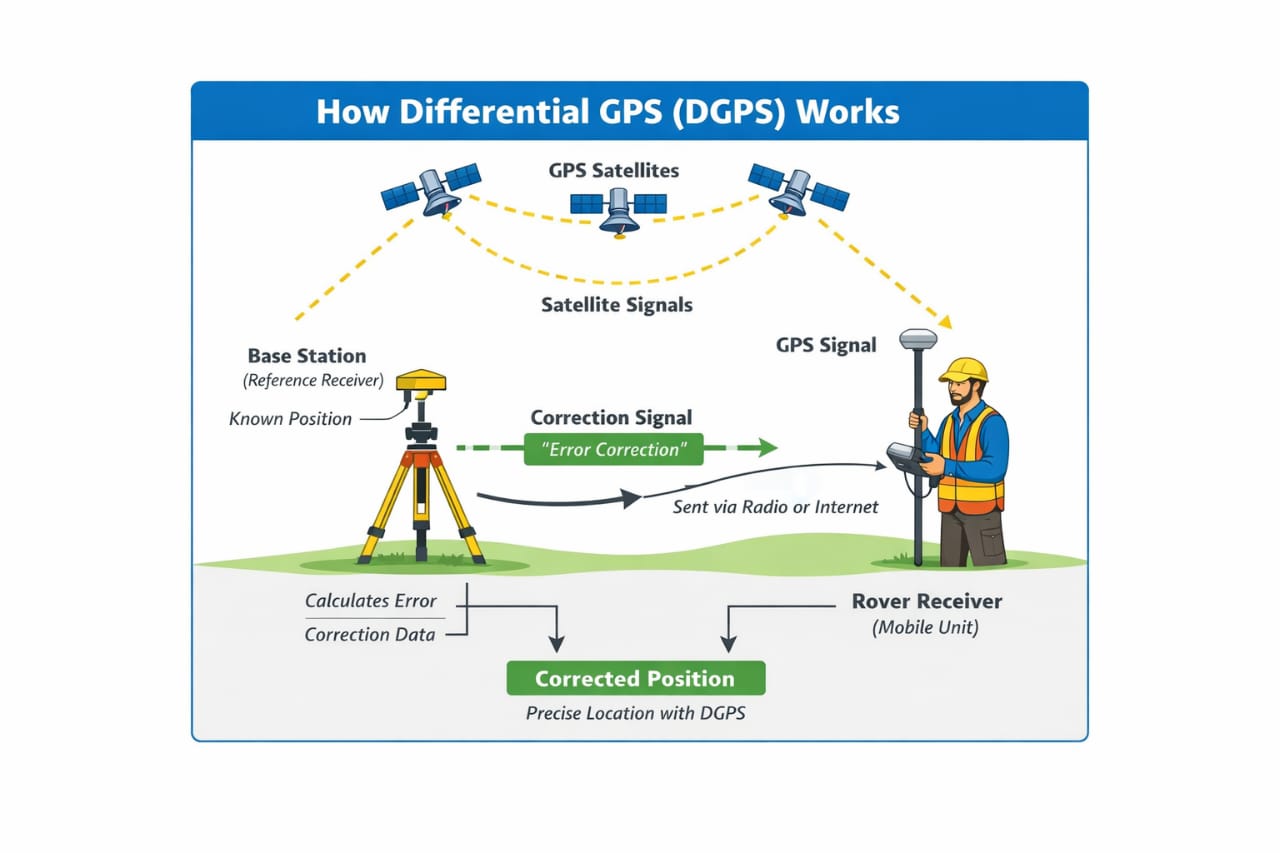
Differential GPS is a method of correcting GPS positioning errors by using two GPS receivers:
- Base Station (Reference Receiver) – Placed at a known and fixed coordinate.
- Rover Receiver (Mobile Receiver) – Used by the surveyor to collect field data.
The base station calculates the difference between its known location and the position calculated from GPS satellites. This difference is known as the correction factor, which is then transmitted to the rover receiver to improve its positional accuracy.
DGPS Diagram
Principle of Operation
DGPS works on the principle that GPS errors affecting one receiver will also affect another nearby receiver in nearly the same way.
- GPS satellites transmit signals to both the base station and rover receiver.
- The base station calculates its position from satellite signals.
- It compares this calculated position with its known coordinate.
- The difference between the two positions is determined as the correction.
- This correction is sent to the rover receiver.
- The rover applies the correction to obtain a more accurate position.
Sources of GPS Errors
Several factors can introduce errors into GPS measurements. DGPS helps reduce or eliminate these errors.
- Satellite clock errors
- Orbital (ephemeris) errors
- Atmospheric delays (ionosphere and troposphere)
- Multipath errors (signal reflections)
- Receiver noise
Types of Differential GPS Used in Surveying
Real-Time DGPS
In Real-Time DGPS, corrections are transmitted instantly from the base station to the rover receiver through radio signals or internet communication.
- Immediate corrected positions
- Faster fieldwork
- Suitable for construction and engineering surveys
Accuracy typically ranges from sub-meter to centimeter level.
Post-Processed DGPS
In this method, field data is collected first and corrections are applied later during office processing using specialized software.
- Very high accuracy
- Suitable for geodetic and scientific surveys
Equipment Required for DGPS Survey
- Base GPS receiver
- Rover GPS receiver
- Communication link (radio or GSM)
- Tripod and tribrach
- Data collector or field controller
- Power supply
Applications of DGPS in Surveying
- Topographic surveying
- Control point establishment
- Cadastral surveying
- Hydrographic surveying
- Construction layout
- Pipeline and road surveys
- GIS data collection
Advantages of Differential GPS
- High positioning accuracy
- Real-time corrections
- Faster data collection
- Reduced human errors
- Ability to cover large areas quickly
Limitations of Differential GPS
- Requires at least two receivers (base and rover)
- Accuracy decreases as the distance from the base station increases
- Signal obstruction from buildings, trees, or terrain can affect results
- Requires communication between the base and rover
Conclusion
Differential GPS has revolutionized the field of surveying by providing highly accurate positioning in a relatively short time. By correcting errors in satellite signals using a base station and rover receiver, DGPS enables surveyors to obtain precise coordinates required for mapping, construction, engineering, and land development projects.
As technology continues to advance, DGPS and other GNSS techniques will remain essential tools for professional surveyors worldwide.
